
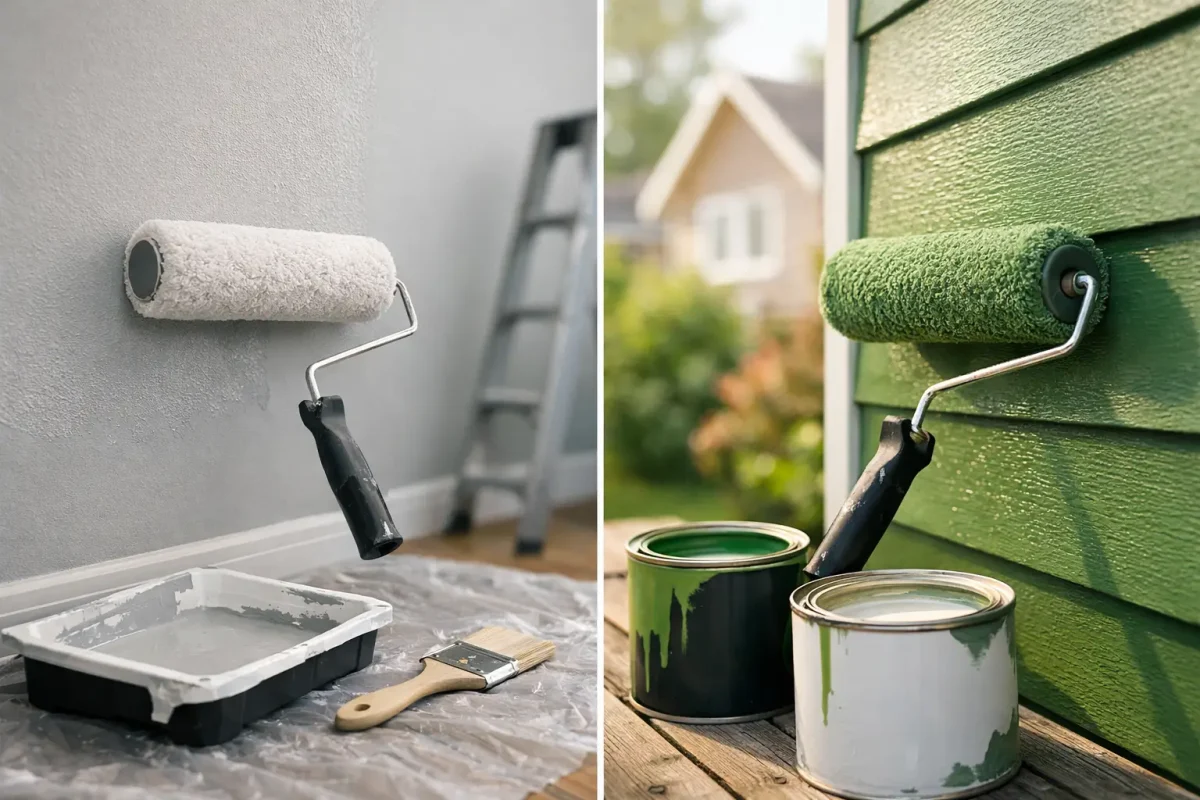
Paint problems usually show up after the contractor has packed up. A wall starts scuffing too easily, an exterior coating fades faster than expected, or a surface that looked fine on day one begins to peel once heat, moisture or cleaning routines take over. That is where the interior exterior paint difference matters. Choosing the right product is not a small technical detail – it affects finish quality, maintenance cycles, occupant comfort and how long the job actually lasts.
For property managers, business owners and homeowners alike, the basic question sounds simple: can one paint do both? Sometimes a product can be used across more than one setting, but in most cases interior and exterior paints are designed for very different conditions. Using the wrong one can mean avoidable rework, extra disruption and a shorter coating life.
What the interior exterior paint difference really comes down to
The main interior exterior paint difference is performance under different forms of stress. Interior paint is formulated for enclosed spaces where appearance, cleanability and low odour matter most. Exterior paint is built to cope with sun, rain, temperature swings, airborne contaminants and substrate movement.
That means the resin systems, additives and overall balance of the product are different. Interior coatings often prioritise a smooth, attractive finish and resistance to marking from day-to-day use. Exterior coatings need more flexibility and weather resistance so they can expand, contract and hold up under exposure.
This is why a paint that looks excellent indoors may fail surprisingly quickly outdoors. It is also why some exterior paints, although tougher in some respects, are not automatically the best choice for internal areas where odour, washability and finish consistency are critical.
Why interior paint is made for enclosed environments
Interior walls, ceilings and trim deal with a predictable set of pressures. In a commercial fit-out, school, office or home, the coating has to present well, tolerate regular cleaning and cope with scuffs, fingerprints and general wear. It also needs to dry and cure in occupied spaces without creating unnecessary disruption.
Because of that, interior paints are commonly formulated for lower odour and lower volatile emissions than many heavy-duty exterior systems. They are also designed to give a refined finish on plasterboard, set walls, timber trims and ceilings. In practical terms, that means better levelling, a more consistent sheen and easier maintenance in controlled conditions.
However, interior paint is not built to stand up to prolonged UV exposure, driving rain or wide temperature variation. On an outside wall or soffit, those weaknesses become visible fairly quickly. Fading, chalking, cracking and adhesion failure are all more likely when an interior product is exposed to weather.
Why exterior paint is built differently
Exterior surfaces have a much harder life. In Western Australian conditions, coatings can be exposed to harsh sun, salt-laden air, wind-driven rain and significant heat. Even within the same property, north-facing elevations, shaded walls and high-traffic entry points can age very differently.
Exterior paints are formulated to resist this kind of exposure. They tend to include additives that improve UV resistance, moisture resistance and flexibility. That flexibility is important because substrates move. Masonry heats and cools, timber expands and contracts, and small cracks can develop over time. A good exterior coating has to move with the surface rather than becoming brittle and failing.
That does not mean every exterior paint is the same. Some are best suited to masonry, some to metal, and some to timber or previously painted surfaces. On commercial and strata properties especially, the right system often depends as much on the substrate and condition of the building as it does on whether the work is inside or outside.
Can you use exterior paint indoors or interior paint outdoors?
This is where assumptions cause problems. Interior paint used outdoors is usually the riskier mistake. It may look acceptable at first, but it is generally not formulated to cope with weathering. The result is often premature breakdown and a repaint cycle that arrives much sooner than planned.
Using exterior paint indoors is more complicated. In some service areas, plant rooms or certain industrial settings, an exterior-grade or specialist coating may be appropriate because durability or moisture resistance is the main priority. But for occupied interiors, it is not usually the default choice. Odour, curing characteristics and finish quality all need to be considered properly.
So the answer is not simply yes or no. It depends on the substrate, the environment, who uses the space and how the area needs to perform over time. That is why specification matters more than broad labels.
The interior exterior paint difference in finish and appearance
Clients often notice appearance first, but performance should sit behind it. Interior paints are generally expected to produce a more controlled decorative result. In reception areas, offices, retail spaces and homes, consistency of sheen and surface smoothness matter.
Exterior paints can also look excellent, but the formulation is weighted more towards protection than fine decorative presentation. Some finishes may have a different texture or sheen profile because they are doing a harder job. On rendered walls, weatherboards or boundary surfaces, that trade-off is often the right one.
This matters when clients want continuity between indoor and outdoor areas. A matching colour can often be achieved, but the same product and same finish level may not be suitable in both locations. A professional specification takes that into account early, rather than forcing a cosmetic match that causes performance issues later.
Durability is not one-size-fits-all
People often ask which is tougher – interior or exterior paint. The better question is tougher against what. Interior paint may outperform exterior paint when it comes to stain resistance, frequent cleaning or maintaining a clean decorative finish in occupied rooms. Exterior paint will usually outperform interior paint against weather, UV and moisture.
In other words, durability is context-specific. A school corridor, a medical consulting room, a warehouse office and a coastal building facade all need something different. The best result comes from matching the coating to the actual service conditions, not from assuming one premium product will solve every problem.
Preparation still matters as much as product choice
Even the right paint will fail if preparation is poor. That applies to both interiors and exteriors. Grease, chalking, flaking coatings, damp, salts, mould, surface movement and poor repairs all interfere with adhesion and finish quality.
On interior work, proper filling, sanding and priming make the difference between an average finish and a professional one. On exterior work, cleaning, treatment of cracks, stabilising weathered substrates and choosing the correct primer system are often what determine lifespan.
This is one reason larger maintenance and repainting projects benefit from coordinated delivery. When painting is tied to patch repairs, carpentry, plastering or remedial works, the quality of the final coating depends on how well those parts are managed together.
How to choose the right paint system for your property
The most practical way to make the right decision is to start with the surface and the environment, not the colour chart. Ask what the substrate is, how exposed it is, how often it will be cleaned, whether the area is occupied during works and what service life you expect from the finish.
For residential owners, that might mean one system for living areas, another for bathrooms and laundries, and a separate exterior system for rendered walls, timber or metalwork. For commercial clients, the decision is often broader. Presentation, maintenance budgets, access, operational downtime and compliance requirements can all affect product selection.
A lower upfront price can be false economy if the wrong coating shortens the repaint cycle or creates disruption in active buildings. Equally, over-specifying a product where it is not needed does not always deliver better value. Good advice is about fit for purpose, not just buying the highest-sounding grade.
When specialist advice saves time and rework
The bigger or more complex the property, the less useful general paint advice becomes. A childcare centre, flat complex, office tenancy and industrial facility may all need painting, but they do not need the same coating strategy.
This is where an experienced contractor adds value beyond application alone. Surface assessment, moisture issues, access constraints, sequencing with other trades and long-term maintenance planning all influence the result. For clients managing multiple assets or live environments, that joined-up approach usually saves more than it costs.
At WADECO – MTMS, that practical view matters because painting is rarely an isolated task. It often sits alongside repairs, refurbishment and presentation upgrades that need to be organised properly to avoid unnecessary delays or repeat visits.
If you are weighing up paint options, the helpful question is not which product sounds toughest. It is which system is right for the surface, the setting and the way the property needs to perform once the job is finished.





2 Comments
[…] often ask which brand offers the best interior exterior paint, but brand is only part of the answer. Preparation, specification and application usually determine […]
[…] Interior and exterior surfaces should be reviewed separately because their demands are different. Internal spaces may need low-odour products, quick drying times, and a finish that can withstand cleaning in high-traffic areas. Externals need systems suited to sun exposure, moisture, wind-driven dirt, and the general wear that comes with Western Australian conditions. […]