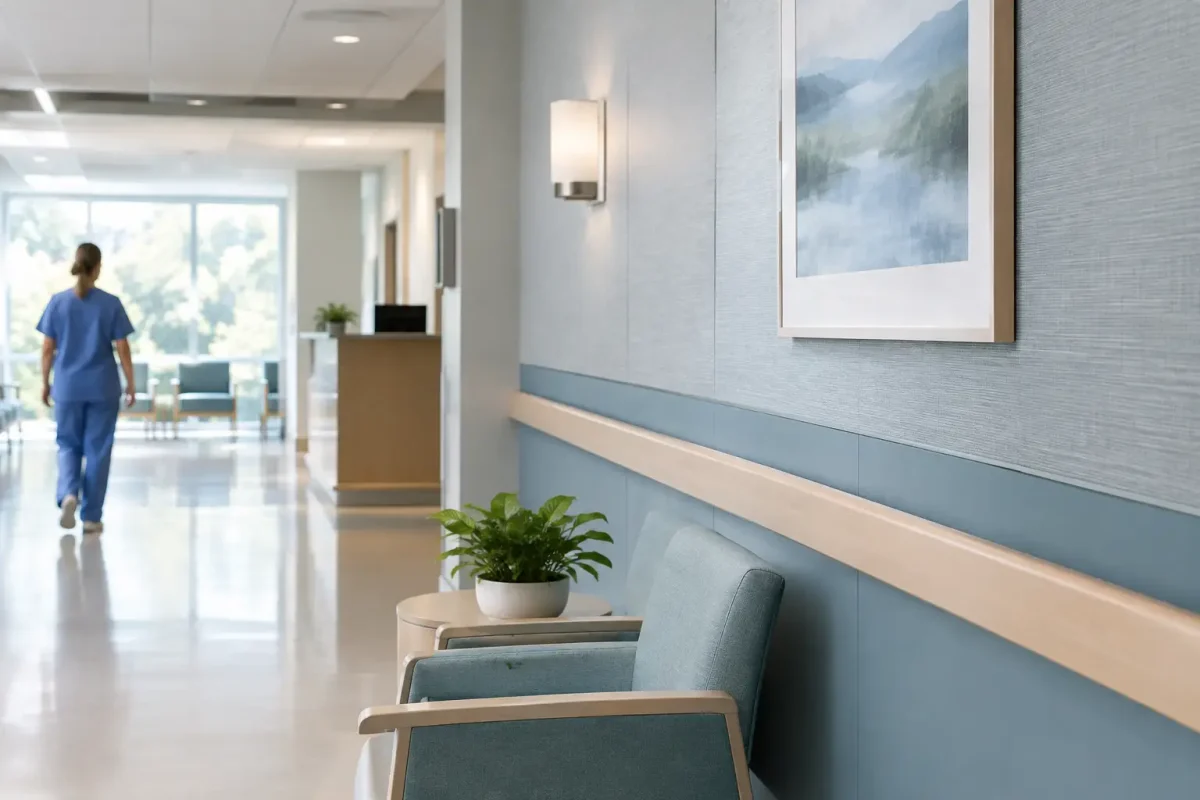
A scuffed corridor, lifted vinyl edge or stained waiting-room wall is more than a presentation issue in a medical setting. It can create cleaning difficulties, undermine patient confidence and add another item to an already busy maintenance list. The right wall coverings for healthcare facilities help protect high-contact spaces while supporting a cleaner, calmer and more professional environment.
For facilities managers, the decision is rarely just about colour or pattern. A wall finish must stand up to frequent cleaning, trolley traffic, impacts, hand contact and the practical demands of keeping clinical and public areas operational. The best result comes from selecting the right product for each room, preparing the substrate properly and managing installation around the facility’s daily activity.
What healthcare wall coverings need to do
Healthcare buildings place different pressures on finishes than standard offices or retail spaces. Corridors, patient rooms, reception areas, treatment spaces and amenities can all require a different level of protection. A single decorative finish across every area may look consistent at handover, but it is unlikely to provide the same long-term value everywhere.
A suitable wall covering should be cleanable, durable and appropriate for the room’s level of use. In busy circulation areas, resistance to knocks and abrasion is often the priority. In clinical areas, the ability to maintain a hygienic surface and minimise joints or difficult-to-clean details may carry more weight. In waiting rooms and consultation areas, appearance, acoustic comfort and a less institutional feel may also influence the specification.
The product must also work with the building itself. Existing wall condition, moisture exposure, fire requirements, ventilation, cleaning products and maintenance access all affect the right choice. This is why a site assessment is more useful than choosing from a sample book alone.
Choosing wall coverings for healthcare facilities by area
There is no single best wall covering for an entire hospital, clinic, aged care home or allied health practice. The right solution depends on how the space is used and what happens there every day.
Corridors, entrances and high-traffic routes
These areas receive the hardest treatment. Beds, wheelchairs, trolleys, delivery equipment and cleaning machines can quickly mark painted plasterboard. Heavy-duty vinyl wall covering, combined with properly installed corner guards or wall protection where required, can provide a more resilient finish than standard paint alone.
Textured or patterned finishes can help disguise minor scuffs, although heavily embossed surfaces may be less suitable where intensive cleaning is required. The practical balance is to choose a finish that is tough without creating unnecessary cleaning challenges.
Patient rooms, consultation rooms and waiting areas
These spaces need to feel cared for rather than overly clinical. Calm colours, subtle textures and well-considered feature walls can improve the experience for patients, visitors and staff. Wall coverings can also help create clearer wayfinding between departments or zones without relying on excessive signage.
Durability still matters. Choose materials that tolerate routine cleaning and can be repaired or replaced in sections if damaged. In facilities with vulnerable occupants, such as aged care or behavioural health settings, product selection should also consider safety, cleanability and the demands of the specific environment.
Wet areas, treatment rooms and utility spaces
Moisture, splashing and frequent chemical cleaning make these areas more demanding. Standard wallpaper is generally not appropriate. Depending on the room and its exposure, hygienic vinyl systems, sheet wall linings or specialist protective coatings may offer a more suitable solution.
The key issue is not simply whether a surface can be wiped down. It is whether the complete system, including seams, adhesive, edges and penetrations, performs reliably in that environment. Poor detailing around basins, splash zones and service points is a common reason otherwise good-looking work fails early.
Hygiene is about the complete finish system
Wall coverings do not replace cleaning procedures or infection prevention controls. What they can do is provide a surface that supports regular cleaning and avoids avoidable defects where dirt and moisture can collect.
For healthcare applications, smooth, non-porous and washable surfaces are often preferred in areas subject to higher cleaning frequency. Seams should be professionally formed and finished so they remain secure over time. Where a product is specified for hygienic use, installation methods must follow the manufacturer’s requirements. Cutting corners on adhesives, joint treatment or substrate preparation can compromise the performance of the entire system.
Cleaning compatibility should be checked before selection. A wall covering may perform well with mild detergent but deteriorate when exposed repeatedly to stronger cleaning agents. Facility teams should confirm what products are used on site and how often surfaces are cleaned. This avoids installing a finish that looks suitable on paper but does not match the real maintenance routine.
Durability starts behind the wall covering
The quality of the surface underneath is just as important as the covering itself. Healthcare buildings often have a mix of aged plaster, plasterboard repairs, previously painted walls and areas affected by moisture or movement. Applying a new finish over an unstable surface can lead to bubbling, joint failure, visible imperfections and premature lifting.
Before installation, walls should be inspected for loose coatings, cracks, dents, dampness and contamination. Repairs may involve plastering, patching, sanding, sealing or moisture investigation before the wall covering work begins. If damage is caused by a leaking pipe, failed sealant or ongoing condensation, the underlying issue needs to be addressed first. Replacing the finish without resolving the cause simply creates repeat work.
This is where a coordinated contractor can reduce unnecessary delays. Rather than asking the facilities team to arrange separate trades for repairs, painting and wall covering installation, the work can be planned as one managed programme with a single point of contact.
Design for maintenance, not just handover day
A healthcare refurbishment should still look good years after completion. That means choosing colours and details that work with the building’s long-term upkeep, not only the initial design concept.
Very light finishes can make a space feel bright, but may show marks quickly in busy corridors. Very dark colours can conceal scuffs but may make smaller rooms feel closed in. Mid-tones, restrained patterns and protective finishes in high-contact zones often offer a practical middle ground. The same applies to feature walls: they can create warmth and identity, but should be positioned where they will not be constantly struck by equipment or exposed to heavy cleaning chemicals.
It is also worth considering future repairs. A product that remains available, can be colour matched or can be replaced in a localised section is easier to maintain than a short-run decorative finish with no replacement option. Keeping a small quantity of approved material on site can be sensible for larger facilities.
Plan installation around patients, staff and services
The best wall covering project is one that improves the facility without disrupting care. In an active healthcare environment, access, noise, dust, odour and safety controls all need to be considered before work starts.
Installation may need to be staged by room, corridor section or department. Out-of-hours work can reduce disruption in some settings, although it must be balanced against security arrangements, ventilation and the availability of site representatives. Clear separation of work areas, careful material handling and daily clean-downs help protect staff, patients and visitors throughout the programme.
Low-odour products and appropriate ventilation planning can also make a meaningful difference, particularly in occupied buildings. Where vulnerable patients are present, the project team should follow site-specific requirements for access, infection control, dust management and communication. A dependable contractor will clarify these requirements during planning rather than trying to manage them after work has begun.
Ask the right questions before approving a product
When comparing wall coverings, look beyond the sample and the installed price. Ask how the material performs with your cleaning regime, what preparation is required, whether it is suitable for the intended room, and how damaged sections can be repaired. Confirm relevant fire and product performance documentation against the project requirements, rather than relying on general descriptions.
It is also sensible to review the junctions between wall coverings, doors, skirtings, handrails, splashbacks and service penetrations. These details often determine whether the finish remains neat and functional over time. A well-managed scope should identify the complementary trades needed for repairs, protection works or reinstatement before the installation date.
For healthcare facilities, wall coverings are a practical investment in hygiene support, durability and patient-facing presentation. Selecting the right system and installing it properly gives maintenance teams fewer avoidable defects to manage and helps each space continue to feel safe, clean and cared for. WADECO can coordinate wall covering, painting and associated repair works so refurbishment is managed properly from preparation through to final finish.