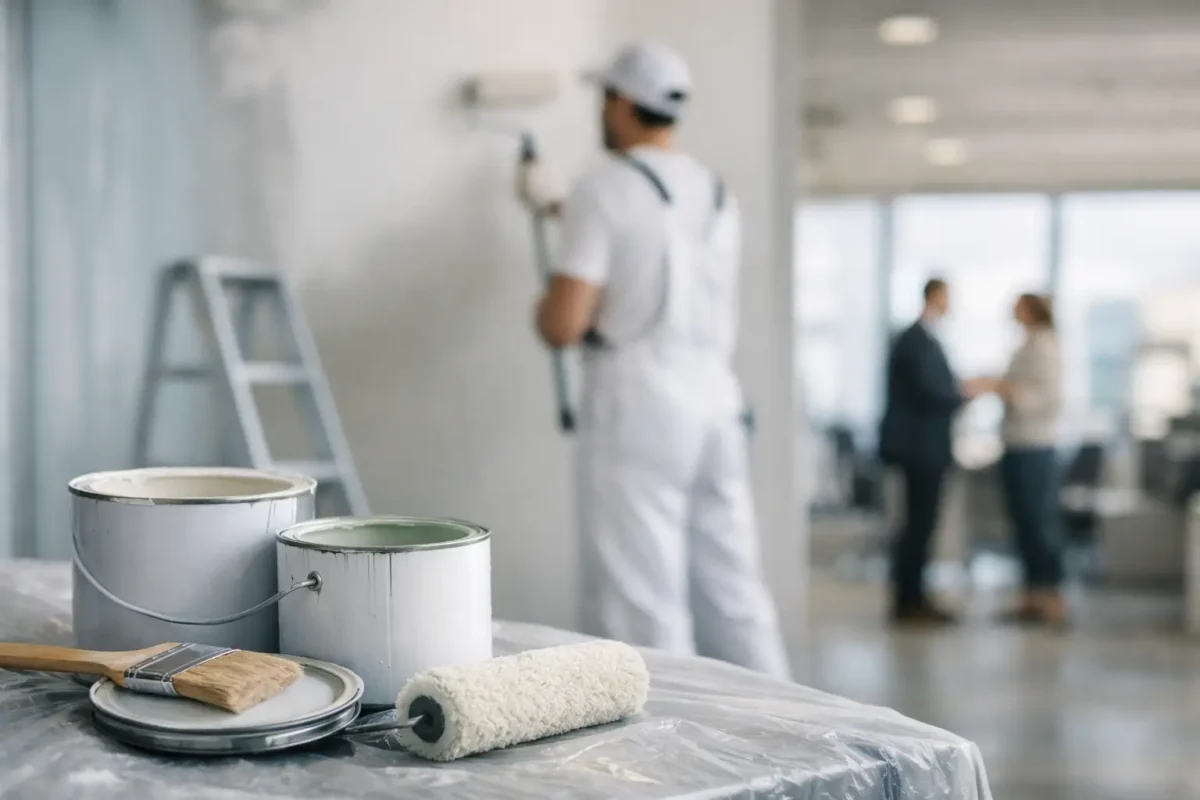
A low odour commercial paints review matters most when a repaint cannot stop the building from operating. In offices, schools, healthcare settings, strata common areas and retail premises, the question is not simply whether a paint smells less. It is whether the coating can be applied efficiently, achieve the required finish and durability, and allow staff, residents or customers to remain comfortable while work is underway.
Low odour products have become a practical choice for occupied commercial sites, but they are not all interchangeable. The right specification depends on the surface, traffic level, cleaning regime, ventilation and programme. Selecting on the label alone can create avoidable issues with coverage, touch-up appearance or long-term maintenance.
What low odour actually means
Low odour describes the smell released during and shortly after application. It is often associated with water-based paints and lower volatile organic compound (VOC) formulations, but the two terms should not be treated as identical. A product can have a mild odour while still requiring sensible ventilation and site controls. Equally, a low-VOC claim does not automatically make a coating suitable for every occupied environment.
For property managers, the practical benefit is reduced disruption. Strong solvent smells can prompt complaints, restrict access to meeting rooms or corridors, and make after-hours work more difficult to hand back. A low odour system can reduce that pressure, particularly where works need to be staged around tenants or daily operations.
That said, low odour is not a substitute for proper planning. Fresh air movement, drying conditions, isolation of work zones and clear communication with occupants still matter. In sensitive settings, the contractor should confirm the product data, curing requirements and any site-specific requirements before work begins.
Low odour commercial paints review: what to judge
The best commercial paint is rarely the one with the lowest initial price or the shortest drying time printed on the tin. It is the one that performs consistently within the project conditions and supports the client’s maintenance plan.
Finish and coverage
A quality low odour interior paint should provide even opacity, good flow and a consistent sheen across large wall areas. Poor coverage adds coats, labour and disruption. It can also make minor repairs more obvious, particularly under strong office lighting or in entrance areas where presentation is closely noticed.
For broad commercial walls, a washable low-sheen or low-gloss finish is often a sensible balance. It reduces the visibility of surface imperfections compared with higher-sheen finishes while remaining easier to maintain than a basic matt coating. However, walls exposed to frequent cleaning, trolley marks or high hand contact may need a more durable system than standard low-sheen acrylic.
Ceilings need separate consideration. A very flat finish can help conceal minor variations, but the selected product must still suit the substrate and provide reliable coverage. Where staining, water marks or nicotine contamination is present, a stain-blocking primer may be required before the finishing coats. A low odour topcoat will not solve an underlying surface problem.
Durability in real use
Commercial spaces receive more wear than most residential interiors. Corridors, lift lobbies, amenities, stairwells and reception areas are cleaned regularly and often take knocks from bags, furniture and equipment. Paint that looks good on handover but scuffs quickly creates an ongoing maintenance cost.
Scrub resistance, stain resistance and repairability should therefore be assessed together. Some highly durable coatings are excellent in high-traffic zones but can make spot repairs more noticeable if the sheen differs from the surrounding wall. Other products touch up well but may be less suitable for aggressive cleaning. The right answer depends on how the area is used, not a blanket preference for one finish.
For warehouses, plant rooms and external substrates, low odour decorative paint may not be the correct specification at all. Protective coatings can be necessary where there is moisture, corrosion, chemical exposure or heavy abrasion. These systems need to be chosen for performance first, with odour and occupancy managed through programming and controls.
Drying, curing and access
Fast drying is useful when rooms must be returned quickly, but dry-to-touch is not the same as fully cured. A surface may look ready within hours yet remain vulnerable to marks, cleaning or furniture contact for longer. This distinction is especially relevant when a facility intends to clean a newly painted area immediately or move equipment back into place.
A professional programme allows for preparation, primer drying, coating intervals and curing before the space is exposed to normal use. Temperature, humidity and airflow can all alter these times. On a Perth project, hot conditions can accelerate surface drying while still leaving other site factors to manage, including ventilation and substrate temperature.
Compatibility with the existing surface
Many repainting failures begin below the new coat. Existing paint may be chalky, contaminated, peeling, glossy or affected by moisture. A low odour product cannot compensate for inadequate preparation, and applying it over an incompatible coating can lead to poor adhesion or early breakdown.
The contractor should inspect the surface, identify repairs, clean contaminants, abrade glossy areas where needed, and use the appropriate primer or sealer. This is also where multi-trade coordination can save time. If plaster repairs, leaking plumbing, damaged trims or electrical alterations are needed before painting, they should be resolved in the right sequence rather than patched around after the finish is applied.
Where low odour systems work particularly well
Low odour commercial paints are well suited to occupied interiors where appearance and continuity are both priorities. Offices can often be completed in sections outside peak hours. Schools and childcare facilities benefit from reduced smell during holiday or staged maintenance works. Strata foyers and common corridors can remain more comfortable for residents, while retail and hospitality venues can minimise the impact on customers.
Healthcare and aged-care environments require greater care. Low odour paints can be part of the solution, but product selection must be considered alongside infection-control procedures, occupant sensitivities, ventilation and access restrictions. The coating should be specified for the environment rather than selected solely because it is marketed as low odour.
Questions to ask before approving a paint system
A clear scope avoids assumptions between the property owner, facilities team and contractor. Ask what surface preparation is included, how many coats are required, what finish level is expected and whether the product is rated for the cleaning regime. Confirm how areas will be isolated, ventilated and handed back, particularly where occupants will remain on site.
It is also worth asking how colour consistency and touch-ups will be handled. Keeping accurate records of product, colour, sheen and batch details makes future maintenance more straightforward. On larger sites, a small test area can be useful before committing to a full repaint, especially where lighting, existing colours or substrate condition may affect the final result.
The practical verdict
Low odour paint is a strong option for many commercial repainting projects because it supports a more comfortable, less disruptive work environment. Its value is highest when it is specified as part of a complete system: suitable preparation, the right primer, a finish matched to the traffic level, and a programme that respects drying and curing time.
For facilities managers, the most useful review is not a list of product claims. It is an assessment of how the selected coating will perform on the actual building, under the actual cleaning and occupancy conditions. WADECO can help assess those conditions, coordinate any required repairs or complementary trades, and deliver a painting programme that keeps the property looking professional without creating unnecessary disruption.