
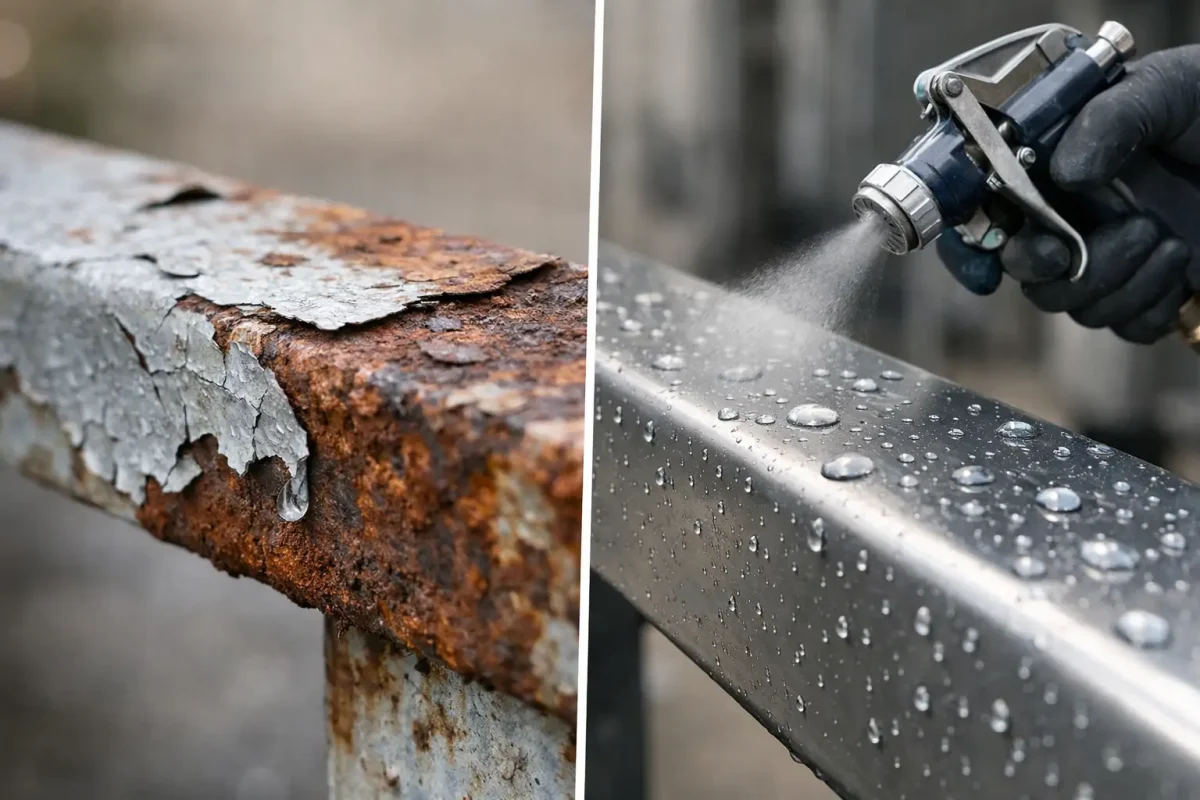
A loading bay wall can look freshly painted on handover and still fail within months. Tyre marks, wash-down water, cleaning chemicals, coastal air and constant contact all place demands on a surface that ordinary decorative paint may not be designed to handle. When considering protective coatings vs paint, the right choice is not simply about appearance. It is about matching the finish to the building element, its environment and the level of service it must withstand.
For property managers, strata stakeholders and business owners, that distinction affects maintenance budgets, downtime and the presentation of the property. A well-specified system can reduce premature repainting and protect the substrate beneath it. A poorly matched one can lead to peeling, corrosion, staining and avoidable disruption.
Protective Coatings vs Paint: The Core Difference
Paint is generally selected to provide colour, coverage and a presentable finish. Quality architectural paint also offers useful protection against weathering, moisture and routine wear. On interior walls, ceilings, offices, common areas and many external façades, a correctly prepared and professionally applied paint system is the practical solution.
Protective coatings are engineered for more demanding conditions. They are designed to create a barrier against a specific risk, such as corrosion, chemical exposure, abrasion, heat, moisture ingress or heavy cleaning. These systems often involve specialist primers, high-build coatings, membrane layers or multi-coat applications that work together rather than a single finish coat.
The terms can overlap. Paint is a type of coating, and some premium paints provide strong protective performance. The useful question is not whether a product is labelled “paint” or “coating”. It is whether it has been specified for the substrate, the exposure conditions and the expected service life of that area.
Where Standard Paint Is the Right Choice
Not every surface needs a specialist coating. Applying an industrial-grade system to a low-traffic internal corridor can add cost and complexity without producing a meaningful benefit. Good commercial painting is often the best fit where the key requirements are a clean appearance, washable surfaces and reliable coverage.
For offices, reception areas, tenancy fit-outs, residential interiors and sheltered common spaces, high-quality acrylic, low-sheen or washable paint systems are usually appropriate. The finish can be selected around practical needs: low sheen for a refined appearance, higher sheen for easier cleaning, or specialty finishes where extra washability or stain resistance is needed.
Exterior paint is also highly effective when the surface is sound and the exposure is normal for the building. On rendered walls, timber trim, masonry and weatherboards, proper surface preparation and the right exterior system can provide years of service. The result depends heavily on addressing cracks, failed sealants, loose coatings and moisture sources before painting begins.
Paint is often the sensible option when the surface will be maintained on a regular cycle. It is readily available in a wide range of colours, easier to refresh during refurbishment works and generally more economical to apply than a specialist coating system.
When a Protective Coating Earns Its Cost
Specialist protective coatings become worthwhile where failure would be expensive, unsafe or highly disruptive. This is common in commercial and industrial settings, but it also applies to exposed building components and high-use areas in residential or strata properties.
Steel is a clear example. If corrosion has begun on gates, balustrades, structural steel, plant supports or external metalwork, a decorative topcoat alone will not stop the problem. The surface needs appropriate preparation, often including removal of corrosion and failed coatings, followed by a compatible anti-corrosive primer and protective topcoat system. In more severe environments, such as coastal locations or areas exposed to salt spray, the specification may need to be significantly more durable.
Concrete floors are another common case. Warehouse floors, workshops, plant rooms, commercial kitchens and car parks may face vehicle traffic, oils, chemicals, impact and repeated cleaning. A protective floor coating such as an epoxy or polyurethane system can improve resistance and make cleaning easier. However, floor coatings are not a cure for every concrete issue. Moisture vapour, weak concrete, oil contamination and movement cracks must be assessed first, or even a premium coating can fail.
Protective systems may also be appropriate for roofs, retaining walls, wet areas, tanks, service rooms and surfaces subject to frequent sanitising. The correct product depends on the actual exposure. A coating that resists abrasion may not be suitable for chemical immersion. A waterproof membrane may not tolerate regular foot traffic unless it is designed for it.
The environment matters as much as the material
A steel handrail in a protected foyer and the same handrail near the coast do not face the same risk. Likewise, a painted wall in a quiet office does not need the same level of performance as a corridor in a school, healthcare facility or hospitality venue.
Before selecting a system, consider whether the surface is exposed to UV, standing water, salt, cleaning agents, impact, foot traffic, forklifts, heat or food-grade hygiene requirements. Also consider access. If repainting a façade requires elevated work platforms, the cost of future maintenance may justify a more durable system at the outset.
Preparation Determines the Result
The most expensive coating will not perform as intended if it is applied over an unsuitable surface. This is where many maintenance projects go wrong: the visible finish is treated as the job, while the underlying cause of failure is left in place.
Preparation may include washing, degreasing, sanding, scraping, patching, crack repair, rust treatment, abrasive blasting or removal of previous coatings. The required level depends on the substrate and the coating specification. Metalwork with active corrosion needs more than a quick sand and repaint. Concrete with moisture issues needs investigation before a non-breathable coating is selected.
Compatibility also matters. New coatings must bond to the existing surface or to a properly prepared primer layer. Applying an incompatible product can cause lifting, crazing or poor adhesion, particularly where old coatings are glossy, chalking or unknown.
For occupied properties, preparation needs to be managed around operations. Dust control, access planning, noise limits, cure times and safe segregation of work areas all affect how smoothly the job runs. A coordinated contractor can plan painting, repairs and related trades around the site’s operating requirements rather than creating separate disruptions for each task.
Cost: Initial Price Versus Whole-Life Value
Standard paint usually has a lower initial cost than a specialist protective system. It often requires fewer stages, less intensive preparation and simpler application. That makes it an efficient choice where the surface can be repainted easily and where exposure is moderate.
Protective coatings can cost more because the product, preparation standard and application process are more demanding. Some systems require strict mixing ratios, specific film thicknesses, controlled drying conditions or longer cure periods. These are not unnecessary extras. They are part of achieving the performance the coating is meant to provide.
The better value is determined by the consequence of failure. Repainting a meeting room wall is straightforward. Repairing corroded steel, closing a loading area, replacing damaged flooring or dealing with water ingress is not. Where a protective coating extends the maintenance cycle and reduces repair risk, the higher initial outlay can be justified.
That said, a more expensive specification is not automatically better. Over-specification wastes budget, while under-specification creates rework. The aim is a system that is fit for purpose, maintainable and appropriate for the property’s planned use.
Questions to Ask Before You Specify
A clear scope starts with practical information. What is the substrate? What has failed previously? Is there moisture, corrosion, movement or contamination? How is the area used each day, and how difficult will it be to access for future repairs?
It is also worth considering the desired finish. Protective performance does not mean compromising on presentation. Many specialist systems are available in colours and finishes that suit commercial, strata and residential environments. The key is ensuring the decorative topcoat is compatible with the protective layers beneath it.
For larger maintenance programmes, grouping surface repairs, painting and associated works under one managed scope can help control disruption. WADECO coordinates painting, refurbishment and complementary trades through a single point of contact, helping clients address the condition behind the finish rather than simply covering it over.
Choose for the Surface, Not the Label
The best finish is the one that suits the job in front of it. Use quality paint where appearance, washability and normal weather protection are the priorities. Specify a protective coating where the substrate faces corrosion, chemicals, abrasion, water exposure or difficult access that makes early failure costly.
A proper site assessment before work begins gives you the clearest path forward. It allows the condition of the surface, operational constraints and expected maintenance cycle to guide the specification, so the finished result continues to perform long after the painters have left site.





1 Comment
[…] areas require more than a conventional acrylic. Two-pack epoxy and specialist protective coatings offer exceptional resistance to chemicals, moisture, impact and aggressive cleaning regimes. They […]