
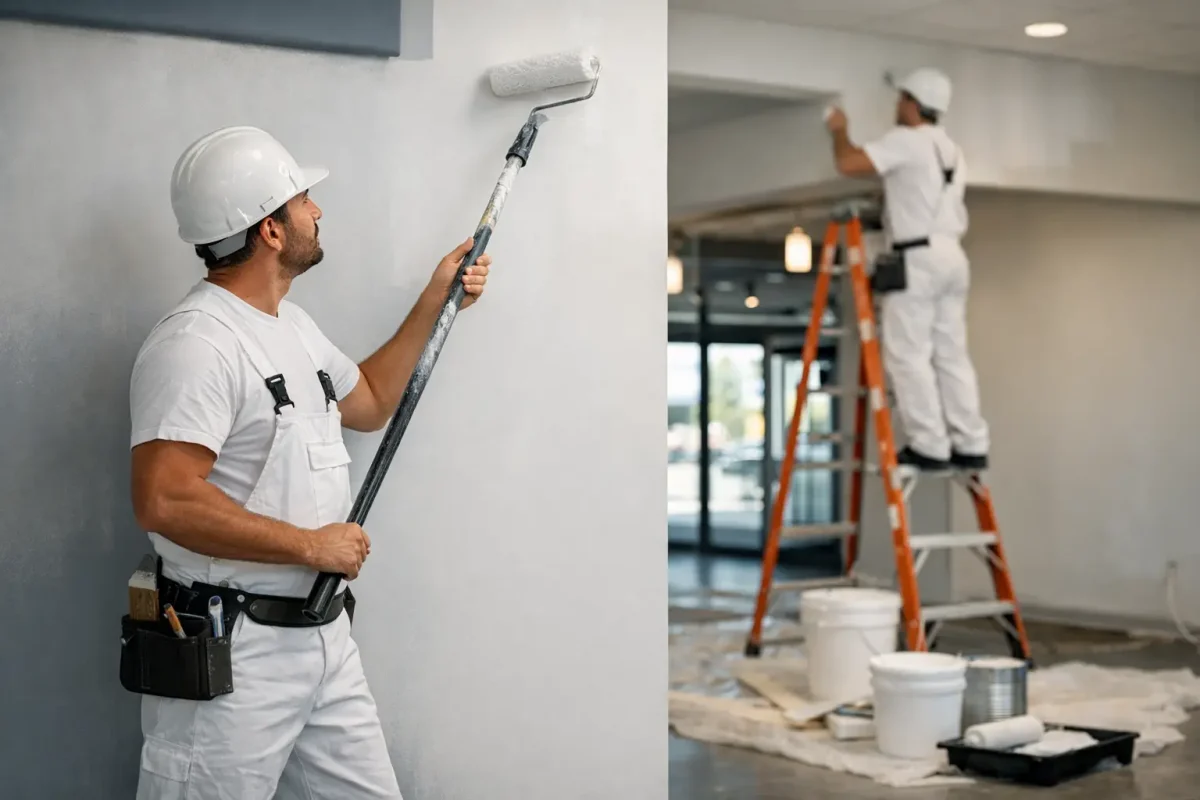
A rushed repaint in a working commercial building usually looks fine for the first few weeks. Then the missed prep starts to show, access issues create friction with tenants or staff, and a job that was meant to solve a presentation problem turns into another maintenance item. That is why searching for professional commercial painters near me is rarely just about paint. It is about finding a contractor who can manage the work properly, protect day-to-day operations and deliver a finish that lasts.
For property managers, facilities teams, strata stakeholders and business owners, the real cost of painting is not only the quote. It is also the disruption, the supervision burden, the need to coordinate other repairs and the risk of rework if the finish fails early. A dependable commercial painting contractor should reduce that burden, not add to it.
What professional commercial painters near me should actually offer
A commercial painting service should do more than send a crew with rollers and drop sheets. In practice, the right contractor brings planning, site management and trade coordination to the job from the start.
That means clear scoping, realistic programme, suitable product selection and proper surface preparation. It also means understanding how different sites operate. An office, school, block of flats, healthcare setting and retail tenancy all have different access, safety and timing requirements. A contractor who treats every site the same will usually miss something important.
Professionalism also shows up in the basics. You want a team that communicates clearly, turns up when scheduled, manages safety requirements and leaves the site in good order. On occupied properties, those things matter just as much as the final coat.
Why local matters in commercial painting
When clients search for professional commercial painters near me, the local part matters for good reason. A contractor working across Perth and Western Australia should understand local building conditions, product suitability and the practical realities of scheduling work around weather, tenants and operational hours.
Exterior coatings, for example, need to stand up to strong sun, heat and coastal exposure in many parts of WA. Interior works often need to be staged around staff, customers, residents or students. A local contractor with experience in these environments is more likely to recommend the right system and the right programme rather than a generic solution.
There is also a practical advantage in responsiveness. If additional repairs are discovered, if access changes, or if a staged programme needs adjusting, a nearby and well-managed contractor is generally easier to deal with than a disconnected operator juggling too many jobs.
The difference between a painter and a managed contractor
This is where many quote comparisons go wrong. Two contractors may price the same building very differently, but they may not be offering the same service.
One may simply price paint application. Another may include detailed prep, protection of surrounding areas, after-hours work, access equipment, coordination with other trades and a proper site management process. The cheaper figure can look attractive at first, but if it leaves the client to organise repairs, tenant communication or follow-up trades, it is not truly cheaper.
For many commercial clients, a single point of contact is a major advantage. If painting work sits alongside plaster repairs, carpentry touch-ups, tiling, electrical isolations or other refurbishment tasks, having one contractor manage the lot saves time and reduces the chance of delays between trades. It also improves accountability. There is less finger-pointing when one team owns the coordination.
How to assess a commercial painting contractor properly
A good contractor should be able to explain how the job will run, not only what it will cost. If the conversation stays vague, that is usually a warning sign.
Start by asking how the scope has been assessed. Have all surfaces been inspected? Are there signs of failure, moisture issues or substrate damage that need addressing before painting starts? If the contractor has not looked closely at condition, the quote may not hold up once the work begins.
Next, ask about programming and disruption control. Can the works be staged by area? Can noisy or high-traffic tasks be scheduled outside business hours? What protection measures will be used around flooring, fixtures, furniture and neighbouring finishes? Commercial painting is often won or lost on planning rather than application alone.
It is also worth asking who will supervise the job and how communication will be handled. Clients should not have to chase updates. A professionally managed contractor will usually set expectations early, confirm access requirements, flag variations promptly and keep the project moving.
What a quality quote should include
A commercial painting quote should be specific enough that you can see what is included and what is not. If it is too broad, problems tend to show up later.
You should expect detail around preparation, repairs, coating systems, number of coats, exclusions, access assumptions and timing. On larger or more sensitive sites, it should also be clear how occupied areas will be managed.
This does not mean the longest quote is always the best. It means the quote should be transparent. If one contractor allows for thorough prep and another barely mentions it, that difference matters. Most coating failures come back to preparation, not the topcoat.
There is also a difference between a realistic quote and a convenient one. A very low price may depend on shortcuts, reduced supervision or an optimistic programme that is unlikely to hold. Commercial clients usually benefit more from certainty than from an unrealistically cheap start point.
Common problems that lead to repainting too soon
Many commercial properties end up repainting earlier than expected, and the reason is not always age. Often it is a combination of surface neglect, poor prep and the wrong product choice.
High-traffic interiors need more than standard decorative paint. Corridors, stairwells, amenities and shared areas often need durable systems that can handle cleaning and repeated contact. Externals face a different challenge, particularly on sites exposed to strong UV, moisture or salt air.
Then there are maintenance backlogs. If cracks, water ingress, failing sealants or substrate movement are left unresolved, repainting alone will not fix the issue. The finish may improve presentation temporarily, but the underlying problem will return. That is why a contractor with broader maintenance capability can be valuable. Painting and repairs often need to happen together.
When it makes sense to bundle trades
A repaint rarely exists in isolation. A wall may need plastering before coating. Timber elements may need carpentry repairs. A refurbishment may require tiling, plumbing or electrical work as part of the programme.
Bundling these trades under one contractor can reduce downtime and simplify the process for the client. Instead of coordinating separate bookings, site inductions and handovers, the work can be sequenced under one plan. That is especially useful in live environments where access windows are tight and disruption needs to be controlled.
This is one reason many commercial and strata clients prefer a multi-trade provider such as WADECO – MTMS. The benefit is not just convenience for its own sake. It is better coordination, cleaner accountability and a more efficient path from defect identification to completed work.
Signs you have found the right fit
The right contractor is usually straightforward to deal with from the beginning. They ask sensible questions, inspect thoroughly, explain the scope in plain terms and do not overcomplicate the process.
They also understand that presentation and durability both matter. A commercial finish has to look good, but it also has to perform. That means selecting appropriate products, preparing correctly and delivering a result that stands up in the real world, not just on handover day.
Just as importantly, they respect the fact that your building still has to function while the works are underway. Good commercial painters think about access routes, occupants, noise, cleanliness and safety from the outset. They do not treat those issues as extras.
If you are comparing options, look beyond the headline rate. The better question is which contractor will get the job done properly, with the least friction and the lowest chance of rework.
A well-run commercial painting project should leave you with more than a fresh finish. It should leave the property easier to manage, better presented and one problem lighter than when you started.



2 Comments
[…] offices, schools, medical facilities, retail sites and flat common areas, the job needs to be planned around people. That includes scheduling noisy […]
[…] It sounds obvious, but it is a common source of repeat work. Presentation matters, especially in commercial settings, but durability matters more. If the underlying issue is unresolved, the repair is […]