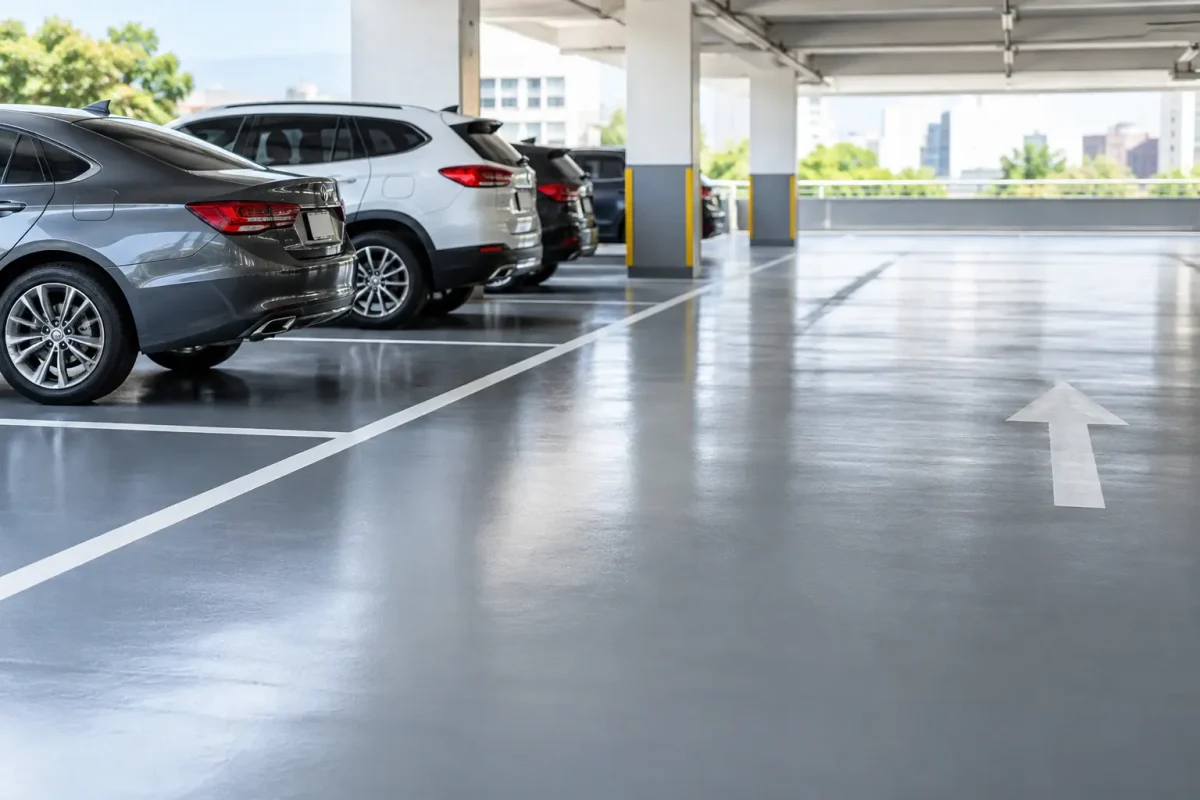
A car park coating is expected to handle far more than tyre traffic. It must stand up to turning vehicles, oil and fuel drips, UV exposure, standing water, pedestrian use and the visual standards of a commercial property. The best coatings for car parks are therefore not simply the toughest product on paper. They are the systems that suit the structure, traffic pattern, drainage and maintenance plan from the outset.
For facilities managers, strata committees and commercial owners, the right decision protects the concrete, improves safety and keeps the site presentable without creating unnecessary closures or repeat repairs.
Start with the car park, not the coating
A ground-level open-air car park has different requirements from a basement, a multi-storey deck or an enclosed loading area. Treating them as the same can lead to premature wear, peeling coatings or water ingress that becomes expensive to rectify.
At-grade concrete is commonly affected by sun, rain, tyre scuffing and localised staining. An elevated deck also has structural movement, joints and waterproofing to consider. Basement areas are protected from UV but may experience reduced ventilation, higher turning loads and moisture vapour rising through the slab. The coating specification needs to respond to those conditions.
Before selecting a system, assess the concrete condition, existing coatings, cracks, drainage falls, traffic volume and vehicle types. Delivery vehicles, rubbish collection vehicles and regular stop-start traffic place particular stress on ramps, entry lanes and turning circles. These areas often need a higher-build or more abrasion-resistant system than parking bays.
The best coatings for car parks by application
There is no single coating that is best for every car park. The following options are widely used because each solves a different maintenance problem.
Epoxy coatings for enclosed areas
Epoxy coatings are a practical choice for enclosed car parks, basements and internal service areas. They provide a hard-wearing, chemically resistant finish that copes well with oils, grease, tyre marks and routine cleaning. They can also give a clean, professional appearance in high-visibility areas.
Their limitation is UV exposure. Standard epoxy can chalk, fade or discolour when exposed to strong sunlight, so it is generally not the first choice for an uncovered top deck. Epoxy also depends heavily on correct surface preparation and moisture control. If the slab is damp, contaminated or poorly prepared, even a quality product may fail.
For basement parking levels, epoxy is often a sensible part of a broader system, particularly when combined with suitable line marking and slip-resistant aggregate in pedestrian and vehicle transition zones.
Polyurethane coatings for exposed parking decks
Polyurethane coatings are valued for flexibility, UV resistance and colour retention. They are well suited to exposed areas where sunlight and temperature changes are part of daily operating conditions. Compared with a standard epoxy, polyurethane is generally better able to accommodate minor movement in the substrate.
This makes it useful for top decks, external ramps and open parking areas where presentation matters as much as protection. Polyurethane can be specified in a range of colours and finishes, allowing bays, walkways and traffic routes to remain clearly defined.
The trade-off is that polyurethane systems require careful application conditions and proper priming. The product choice, film thickness and aggregate profile should be matched to the expected traffic. A thin decorative coat may look good at handover but will not necessarily perform on a heavily used ramp.
Traffic membranes for waterproofing and movement
Where a car park deck sits above occupied space, retail premises, storage areas or another level of parking, a trafficable waterproof membrane is usually the more appropriate solution. These systems are designed to manage water penetration while tolerating movement and repeated vehicle loads.
A traffic membrane is not just paint. It is a layered protective system that may include primer, membrane coats, reinforcement at cracks and joints, aggregate for slip resistance, and a durable topcoat. It needs detailed attention around drains, upstands, penetrations and expansion joints, as these are common points of water entry.
For elevated decks, the cost of choosing the wrong coating can be significant. Water ingress can affect the concrete, reinforcement, ceiling finishes below and the day-to-day operation of tenants. A correctly specified membrane system is an investment in protecting the building, not simply improving the surface appearance.
MMA systems where closure time is limited
Methyl methacrylate, often referred to as MMA, is a fast-curing resin system. Its key advantage is speed. In the right conditions, areas can return to service much sooner than with conventional systems, which can be useful for busy commercial sites where extended closures are not practical.
MMA can provide good wear resistance and can be built up with aggregate for demanding ramps and drive lanes. However, it has a strong odour during installation and needs experienced application, appropriate ventilation and a clear plan for managing nearby occupants. It is often best reserved for projects where programme constraints justify the additional cost and site controls.
Acrylic coatings for lower-demand areas
Acrylic coatings can offer a cost-effective refresh for light-use areas, particularly where UV resistance and colour are priorities. They are not usually the preferred option for high-traffic ramps, heavy vehicle routes or areas with ongoing water ingress.
Used in the right location, acrylic can improve presentation and provide a serviceable protective finish. Used as a substitute for a heavy-duty traffic system, it is likely to wear early. This is why a site inspection and honest assessment of the expected use matter before any specification is issued.
Surface preparation determines service life
Most coating failures begin below the coating itself. Oil contamination, weak concrete, old failing paint, laitance and trapped moisture can all prevent proper adhesion. A quality system cannot compensate for a poor substrate.
Preparation may involve mechanical grinding, captive shot blasting, scarifying, crack repairs, joint treatment and removal of unsound material. The aim is to create a clean, sound, suitably profiled surface that allows the primer and coating to bond properly.
Moisture testing is equally important, especially in basements and older slabs. Where moisture vapour is present, the system may require a moisture-tolerant primer or vapour-control layer. Skipping this step can lead to blistering or delamination after the car park has reopened.
The same attention is needed for repairs. Cracks should not simply be coated over if they are active or allowing water through. Their cause, movement and location must be understood before selecting a repair detail. Expansion joints need joint systems that continue to move, rather than rigid material that will split under traffic.
Safety, drainage and wayfinding are part of the scope
A well-finished car park is easier and safer to use. Slip resistance should be considered in ramps, pedestrian crossings, stair landings, entry points and areas prone to water or vehicle fluids. More aggregate is not always better, as an overly aggressive profile can be hard to clean and uncomfortable underfoot. The right finish balances grip with cleanability and wear resistance.
Drainage also deserves close attention. Coatings can protect concrete, but they do not solve ponding caused by inadequate falls, blocked drains or damaged outlets. Standing water accelerates deterioration and can create a slip hazard. If drainage repairs, plumbing works or concrete patching are required, it is more efficient to coordinate them before the final coating system is applied.
Clear line marking, directional arrows, bay numbers, accessible parking symbols and pedestrian routes complete the job. These are not decorative extras. They reduce confusion, improve traffic flow and support a better experience for tenants, visitors and staff. Colours should provide enough contrast to remain visible under the available lighting conditions.
Plan the works around operations
Car park coating projects affect access, deliveries, staff parking and tenant operations. The best technical specification can still create frustration if the work is poorly staged. A practical contractor will identify closure zones, vehicle routes, curing periods, noise restrictions and communication requirements before work begins.
Staging the job in sections may allow part of the car park to remain operational. Overnight or weekend work can help in some commercial settings, while fast-curing systems may reduce downtime where access is critical. The appropriate approach depends on the site, available alternate parking and the coating system’s curing requirements.
For multi-trade repair and refurbishment projects, one point of contact also helps prevent gaps between concrete repairs, drainage works, joint treatment, coating application and line marking. WADECO can coordinate these connected requirements so the finished car park is managed as one scope, rather than a series of disconnected trades.
Choose for the next five years, not the next five weeks
The cheapest coating proposal is not always the lowest-cost option over its service life. A system that is unsuitable for UV, moisture or traffic loads may need patching well before a properly specified alternative. That creates repeat closures, inconsistent appearance and avoidable maintenance spend.
Ask how the proposed system will perform in your highest-stress areas, not just in the parking bays. Confirm the preparation method, crack and joint treatment, slip-resistance approach, curing time and what ongoing cleaning or inspection is recommended. These details reveal whether the scope is designed for lasting performance or simply a quick cosmetic refresh.
A car park should look organised, drain properly and give drivers and pedestrians confidence from the moment they enter. Selecting a coating system around the building’s actual conditions is the practical way to keep it that way.