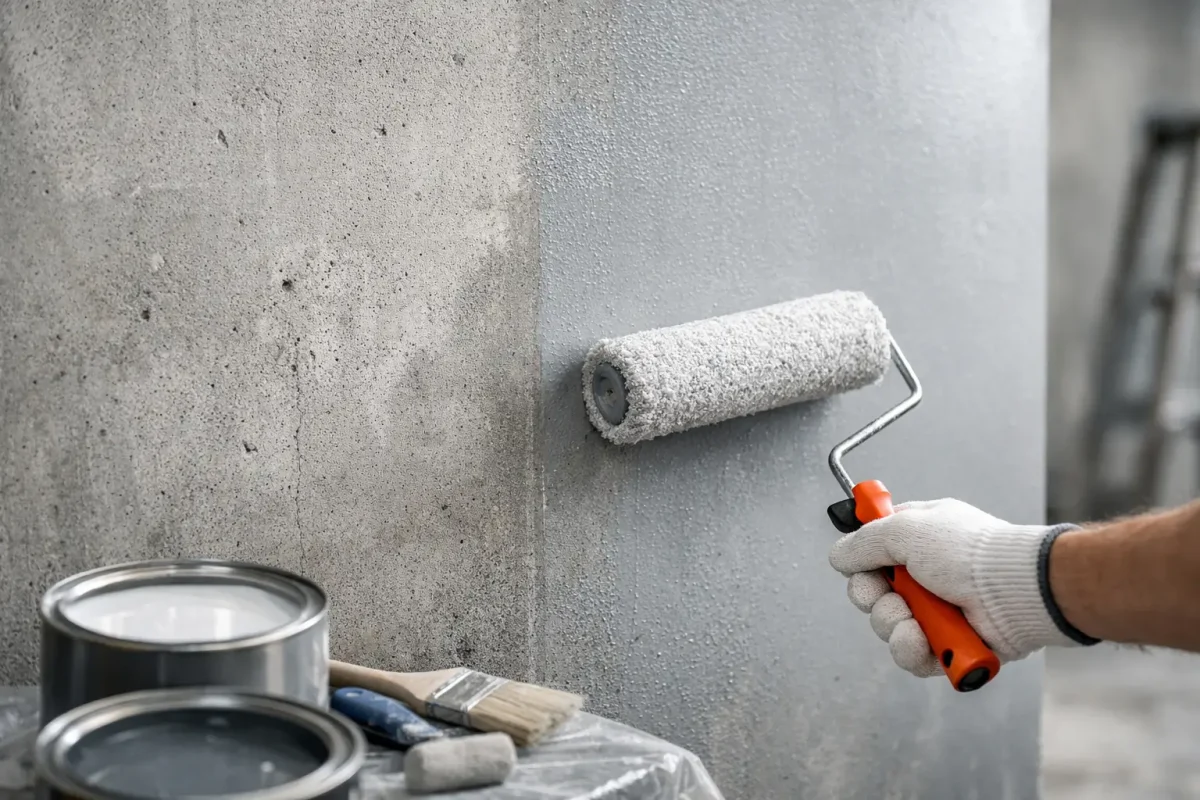
Concrete walls can look sound while quietly absorbing water, collecting salts or allowing hairline cracks to spread. Selecting the best coatings for concrete walls is not simply a colour decision. The right system protects the substrate, improves presentation and helps avoid disruptive, avoidable repair work later.
For commercial sites, strata properties and homes alike, the starting point is always the same: establish what the wall is exposed to, where moisture is coming from and what condition the concrete is in. A coating that performs well on an internal blockwork wall may fail quickly on an exposed boundary wall, retaining wall or plant-room surface.
Start with the wall, not the paint chart
Concrete is durable, but it is also porous. Water can travel through it, vapour can move through it, and salts can be carried to the surface as efflorescence. It may also have release agents, curing compounds, laitance, old coatings or contamination that prevents adhesion.
Before choosing a coating, inspect for cracking, spalling, rust staining, damp patches, mould, chalking paint and white salt deposits. The source of any moisture matters. Rain-driven water from the exterior, rising damp, failed drainage and water pressure behind a retaining wall all call for different remedial work.
Coating over an active moisture problem is rarely a durable fix. If water is entering from behind the wall, the preferred solution is normally to address drainage, membranes or external waterproofing first. Applying a surface coating to the inside may improve appearance temporarily, but pressure can cause blistering, peeling or coating failure.
The best coatings for concrete walls by application
There is no single best product for every concrete surface. The most suitable option depends on exposure, expected movement, appearance requirements and the level of cleaning or impact the wall will receive.
Acrylic masonry coatings for general exterior protection
High-quality acrylic masonry coatings are a dependable choice for many exterior concrete and rendered walls. They provide a consistent decorative finish, good weather resistance and reasonable breathability, allowing moisture vapour to escape without leaving the wall fully exposed.
They suit facades, boundary walls, precast panels and exterior concrete blockwork where the main concerns are sunlight, rain, dirt and presentation. In Perth conditions, UV resistance is particularly relevant, as poorly specified coatings can fade, chalk or lose flexibility over time.
Acrylic systems are not the answer for walls subject to continual water pressure or heavy industrial contamination. They also depend heavily on correct cleaning, repair and priming. A quality topcoat cannot compensate for a dusty, friable or poorly prepared surface.
Elastomeric coatings for hairline cracking
Elastomeric coatings are thicker, flexible protective coatings designed to bridge fine, non-structural cracks. They are often a strong option for ageing external concrete walls that have weathered movement, recurring hairline cracks or minor surface irregularities.
The benefit is flexibility. As the substrate expands and contracts with temperature changes, a properly specified elastomeric film can accommodate limited movement better than a standard masonry paint. This can improve weatherproofing and give large wall areas a cleaner, more uniform finish.
There are limits. Elastomeric coatings are not a substitute for structural crack repairs, failed joints or movement caused by settlement. Cracks that are widening, uneven or associated with water ingress should be assessed and repaired before coating works begin.
Epoxy coatings for demanding internal areas
Epoxy coatings create a hard, durable film with excellent adhesion and resistance to many chemicals, oils and frequent cleaning. They are commonly used on internal concrete walls in workshops, warehouses, service corridors, commercial kitchens, wash-down areas and other high-use spaces.
For facilities managers, epoxy is often the practical choice where walls need to be hygienic, washable and resistant to scuffs. It can also make maintenance easier by creating a smooth, low-porosity finish.
Its trade-off is limited UV stability. Many epoxies can yellow or chalk when exposed to direct sunlight, so they are generally better suited to internal or shaded environments. They also require careful surface preparation and controlled application conditions. Moisture in the slab or wall can compromise adhesion, particularly with less breathable epoxy systems.
Polyurethane topcoats where appearance and wear matter
Polyurethane coatings are valued for colour retention, abrasion resistance and a more refined finish. They are frequently used as part of a system over epoxy primers or base coats where the wall needs to withstand cleaning and physical wear while maintaining its appearance.
They can be suitable for commercial interiors, public-facing areas and protected external applications, depending on the product specification. A polyurethane topcoat may be selected when a standard paint finish is unlikely to hold up to repeated contact, equipment movement or regular cleaning.
As with any specialist system, compatibility matters. Primers, intermediate coats and topcoats should be selected as a complete system rather than mixed from different product ranges without technical approval.
Cementitious waterproof coatings for damp-prone structures
Cementitious waterproofing coatings are often used on concrete walls in basements, lift pits, tanks, retaining structures and service areas where moisture resistance is a key requirement. They bond well to mineral substrates and can tolerate damp surfaces better than many film-forming coatings.
These products are particularly useful where a practical internal waterproofing treatment is needed, but they should be specified with care. A retaining wall with significant hydrostatic pressure may need drainage correction and a waterproofing system applied to the positive side – the side where water enters – rather than relying only on an internal coating.
A cementitious coating may leave a more utilitarian appearance than a decorative paint. If presentation matters, it can sometimes form part of a wider system, with compatible finishing coats added once the waterproofing layer has cured.
Penetrating sealers for a natural concrete finish
Silane, siloxane and other penetrating sealers are useful where the goal is to reduce water absorption while retaining the natural appearance of exposed concrete. Rather than forming a visible film, they penetrate the surface and help repel water.
This approach can suit architectural concrete, exposed precast elements and some external walls where a painted finish is not wanted. It will not hide staining, patch repairs or surface defects, and it is not designed to bridge cracks. The concrete still needs to be clean, dry enough for the product and free from contaminants.
Preparation decides whether the coating lasts
The best coating specification can fail if the surface is not properly prepared. Concrete must be sound, clean and suitable for the selected system. This may involve pressure cleaning, mechanical grinding, abrasive blasting, mould treatment, degreasing, crack repair, patching spalled areas and removing loose or incompatible existing coatings.
Efflorescence must be removed, not merely painted over. Any exposed reinforcement associated with concrete spalling should be assessed, treated and repaired using an appropriate repair mortar. Where movement joints are present, they should remain functional rather than being bridged with rigid filler or paint.
Primers are equally important. A penetrating masonry primer may stabilise a chalky or porous surface, while an epoxy primer can support high-performance internal systems. The correct primer depends on the substrate, moisture condition and the topcoat being used.
For occupied commercial properties, preparation also needs to be organised around operations. Dust control, access planning, protection of adjacent finishes and work scheduling can be as important as the coating itself. A good contractor plans the application system and the site disruption together.
Matching the system to the environment
An external office facade usually needs UV stability, weather resistance and a professional finish. A warehouse wall may need impact resistance and washability. A strata retaining wall may need crack treatment, waterproofing investigation and drainage works before decorative coating can begin.
This is why a site inspection is more valuable than selecting a product by name alone. The coating should be specified as a system that accounts for surface condition, moisture, exposure and the required service life. It should also suit the maintenance plan. A highly decorative finish is of limited value if it cannot be practically cleaned or repaired in a busy environment.
Colour and sheen have an operational role as well. Lighter colours can improve perceived brightness in service areas, while lower-sheen finishes often hide minor surface imperfections better. In high-contact spaces, a finish that can be cleaned without marking may reduce ongoing maintenance costs.
When to bring in a professional
Professional advice is particularly worthwhile when walls show ongoing damp, rust staining, concrete spalling, extensive cracking or failed coatings. These signs can indicate an issue that needs repair before painting begins.
WADECO can coordinate concrete repairs, surface preparation, protective coating application and complementary trades through a single point of contact. That reduces the risk of one contractor repairing a surface while another applies a coating that is unsuitable for the final condition.
The right choice is the coating system that matches the wall’s actual exposure, not the one with the strongest claim on the tin. A properly prepared and professionally applied system protects the concrete, maintains the property’s presentation and gives owners a clearer path to planned maintenance rather than repeated patch repairs.