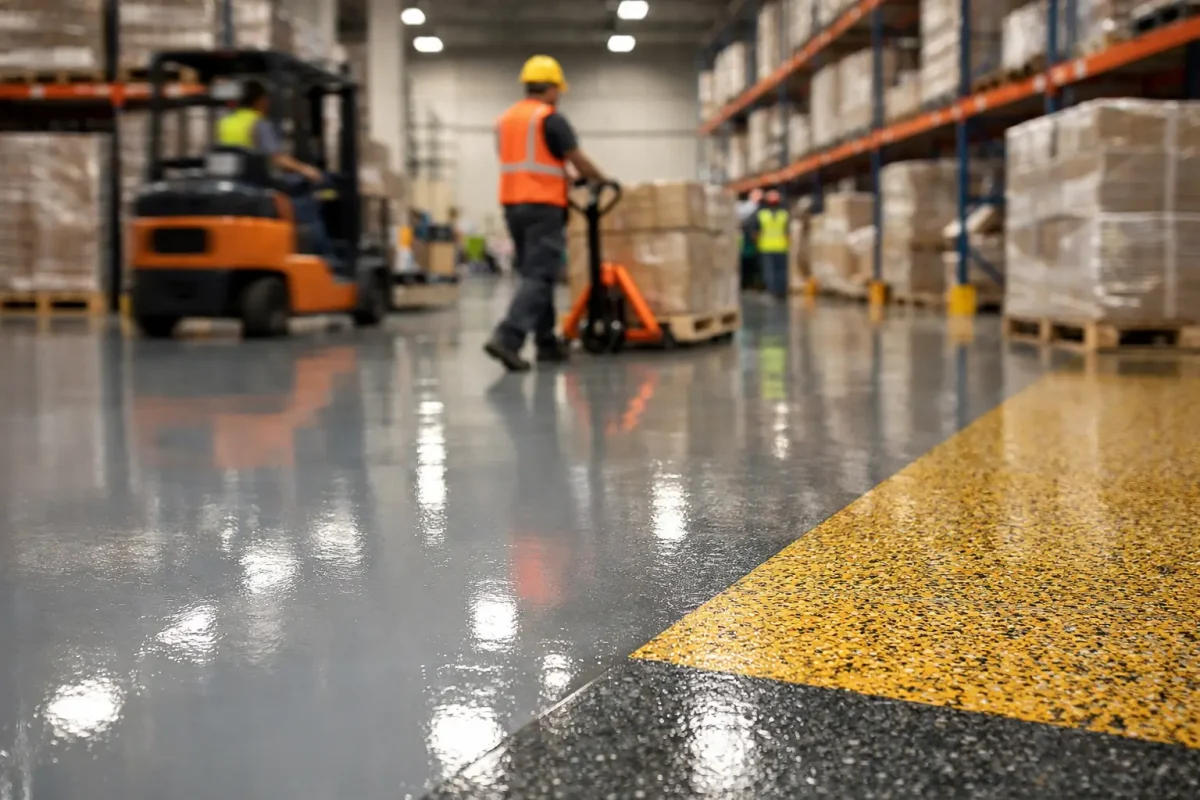
A warehouse floor can look acceptable while quietly creating operational problems. Dusting concrete affects stock and equipment, oil contamination becomes a slip risk, and surface damage can make forklift traffic rougher and more disruptive than it needs to be. The right warehouse floor coating options protect the slab, improve presentation and support safer day-to-day operations – but only when the system suits the site.
For facilities managers and commercial property owners, the decision is rarely about choosing the toughest product on a data sheet. It is about matching a coating to traffic, chemical exposure, cleaning routines, downtime limits and the condition of the existing concrete. A coating that performs well in a light-storage area may not be suitable for a busy despatch zone, cold room entrance or workshop bay.
Start with the demands on the floor
Before selecting a finish, assess how the warehouse is actually used. Forklifts, pallet jacks, racking installation, wheeled trolleys and repeated point loading all place different stresses on a floor. Heavy traffic can wear through unsuitable coatings, while dropped loads and hard wheel turns can expose weak adhesion or poor concrete preparation.
Chemical exposure matters just as much. Warehouses may handle fuels, oils, batteries, cleaning agents, food products or industrial materials. Even a small amount of regular spillage can shorten the life of a standard coating. Wet areas also need a different approach from dry storage zones, particularly where slip resistance and hygiene are priorities.
The existing slab should be inspected as well. Moisture rising through concrete, cracks, old paint, laitance and contamination can all compromise a new finish. Good floor coating work begins with substrate assessment and preparation, not the coating tin.
Common warehouse floor coating options
Epoxy coatings
Epoxy is one of the most widely used commercial floor coating systems. It provides a hard, durable finish with good resistance to abrasion, oils and many chemicals. It is available in a broad range of colours and can be built up to different thicknesses, making it practical for warehouses, workshops, plant rooms and loading areas.
A standard epoxy coating is a sensible choice for dry internal spaces with regular forklift and foot traffic. It can also improve light reflectivity, helping the warehouse feel cleaner and better maintained. For businesses with marked pedestrian routes, work zones or storage areas, line marking can be incorporated as part of the wider floor programme.
Epoxy does have limitations. Some products can yellow where they receive sustained UV exposure, so it is not always the best standalone finish near open loading doors or in areas with strong sunlight. It also needs appropriate curing time. Rushing the return to service can lead to tyre marking, damage or premature wear.
Polyurethane coatings
Polyurethane coatings are often selected where flexibility, UV stability and long-term appearance are important. They generally cope better than epoxy with movement in the substrate and temperature changes, and they are less likely to discolour in bright areas.
In a warehouse setting, polyurethane can be a suitable topcoat over epoxy systems, particularly around entries, external-facing bays and areas that need a more resilient finish. It is also useful where a slightly more flexible coating is required. The exact system depends on the traffic level and whether the floor will be exposed to chemicals or frequent wet cleaning.
The trade-off is that polyurethane is not automatically the answer for every heavy-duty floor. Some areas need the higher build and impact resistance of a specialised epoxy or resin system beneath it. Product choice should follow the operational requirements, rather than relying on one coating type throughout the building.
Polyaspartic and fast-cure systems
Where downtime is the deciding factor, fast-cure resin systems such as polyaspartics may be worth considering. These coatings can cure more quickly than conventional systems, allowing some floors to return to service sooner. That can be valuable in active warehouses where closing an aisle or loading zone for several days is not practical.
Fast curing does not remove the need for careful preparation. Grinding, repair work, moisture management and cleaning still need to be completed properly. It also requires experienced planning, because the shorter working time leaves less room for error during application.
These systems can be a good fit for staged refurbishment works, such as treating one section at a time while the rest of the warehouse remains operational. They may carry a higher upfront cost, but reduced disruption can make the overall project more economical.
Concrete densifiers and sealers
Not every warehouse needs a film-forming coating. Concrete densifiers penetrate the slab and react with the surface to reduce dusting, improve hardness and make cleaning easier. They retain a more natural concrete appearance and are commonly used where a simple, low-maintenance finish is preferred.
A densifier can work well in dry storage warehouses with moderate traffic, particularly where the concrete is sound but dusty. It is not designed to provide the same level of chemical resistance, colour consistency or crack-bridging as a resin coating. If the floor needs a defined visual standard, heavy spill protection or anti-slip texture, a coating system is usually more appropriate.
Penetrating sealers may also help resist staining and moisture absorption. Their suitability depends on the slab and the contaminants involved. They are best viewed as protective treatments rather than a replacement for a heavy-duty industrial coating.
Anti-slip finishes and aggregates
Slip resistance should be specified for the actual environment, not added as an afterthought. Smooth resin floors can be easy to clean, but a floor that becomes wet from washdown, rain at loading doors or product spills may need an aggregate broadcast or textured finish.
More texture generally increases grip, but it can also make cleaning more demanding. In a food-related or high-hygiene facility, the balance between slip resistance and cleanability needs particular care. The right aggregate size and coating build can provide practical traction without creating a surface that traps dirt.
Preparation determines performance
Most premature coating failures trace back to preparation issues. Concrete must be mechanically prepared to remove weak material, old coatings, dirt and contaminants. Depending on the floor, this may involve diamond grinding, shot blasting, scarifying, crack repairs or local patching.
Moisture testing is also essential. A slab can appear dry on the surface while still releasing moisture vapour that affects adhesion. Where moisture is elevated, a suitable moisture barrier or vapour-control primer may be needed before the main coating system is applied.
Repairs should not be overlooked. Cracks, failed joints and damaged edges need treatment before coating begins. Some movement joints need to remain flexible rather than being rigidly filled. A practical specification accounts for these details so the finished floor performs as a system, not simply as a painted surface.
Plan the work around warehouse operations
Coating a warehouse floor does not always mean emptying the entire building. A staged programme can divide the floor into workable zones, coordinate access routes and protect critical despatch or storage areas. Clear scheduling is particularly important where forklifts, staff and contractors must operate safely around the works.
Consider curing periods, ventilation, odour sensitivity and the time needed to move racking or stock. Areas with high traffic may require temporary access plans, while loading zones may need to be completed outside peak delivery hours. A contractor who manages related repairs, line marking and minor refurbishment works through a single point of contact can reduce the coordination burden on site teams.
Choosing a coating that earns its keep
The best warehouse floor coating is the one that solves the site’s real problems without creating new ones. A dense, dust-free finish may be enough for one warehouse; another may require chemical resistance, anti-slip texture, fast return to service and clearly marked traffic routes.
Start with an on-site assessment of the slab and operational demands, then specify the coating system around those conditions. WADECO can coordinate coating preparation and complementary maintenance works with clear planning and minimal disruption. A well-prepared floor gives the warehouse team a safer, cleaner and more dependable surface to work on every day.